APM Terminals Lázaro Cárdenas welcomes new-generation vessel equipped to operate on alternative fuels
Tangier Mærsk can operate on conventional or certified alternative fuels, a technology that supports progress toward reducing greenhouse gas (GHG) emissions in maritime transportation.
APM Terminals Lázaro Cárdenas welcomed the Tangier Mærsk, the first new-generation Maersk container vessel equipped with a dual-fuel engine designed to operate on conventional and certified alternative fuels to call at a Mexican port.
 With a capacity of 9,000 TEUs, its arrival reflects how Mexican port infrastructure is keeping pace with the technological evolution of the maritime sector and strengthening the country’s position in international supply chains.
The arrival of Tangier Mærsk also demonstrates APM Terminals Lázaro Cárdenas’ operational capability to receive new-generation vessels and further strengthens the port’s position within the logistics chains connecting Asia and North America.
The arrival of vessels equipped with technology to use certified alternative fuels is aligned with the Port Decarbonization Strategy promoted by Mexico’s Ministry of the Navy, which encourages the adoption of innovative technologies, digitalization, energy efficiency and the development of infrastructure aimed at improving the performance of Mexico’s ports. In this context, the Port of Lázaro Cárdenas is positioning itself as a relevant hub for the development of maritime routes where logistics efficiency and the reduction of GHG emissions are becoming increasingly important for port competitiveness.
The arrival of Tangier Mærsk demonstrates how port infrastructure, technological innovation and new energy solutions are beginning to converge in the transformation of maritime transportation, helping drive economic growth, strengthen national competitiveness and contribute to reducing GHG emissions across global supply chains.
“At APM Terminals Mexico, we will continue promoting port investments that integrate technological innovation, systematization and new energy solutions. The call of Tangier Mærsk demonstrates that, as a port ecosystem, we are laying the foundations to advance the decarbonization of the sector and to ensure that Mexico plays a leading role in its transformation,” said Beatriz Yera, Managing Director of APM Terminals Mexico.
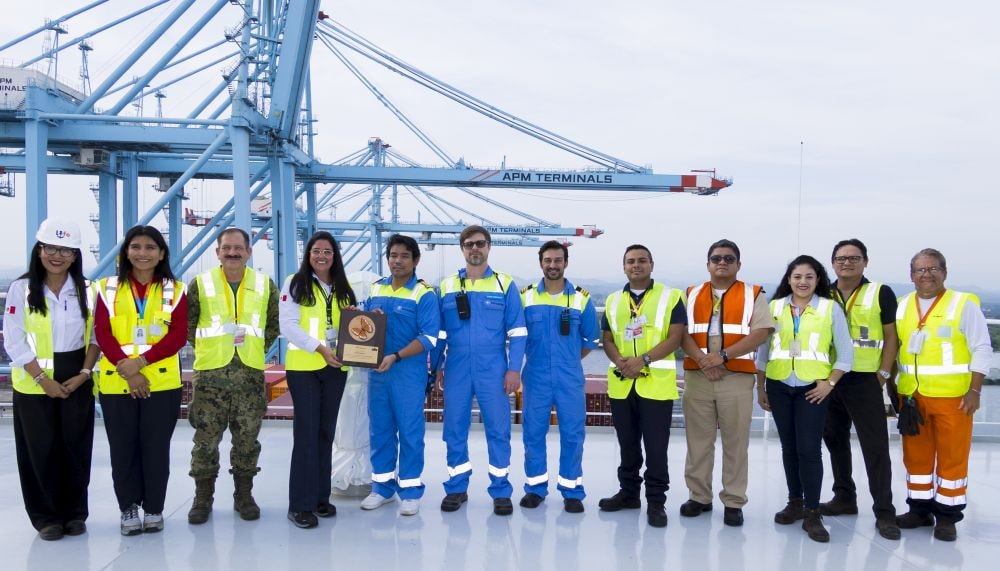
During a tour of the vessel, authorities within the Port of Lázaro Cárdenas had the opportunity to learn first-hand about the technology behind this progress. Beatriz Yera highlighted that operations of this kind help position the Port of Lázaro Cárdenas as a logistics hub with the operational capacity and efficiency required to receive vessels equipped with new technologies. She also emphasized its role as a strategic player in the global supply chains of the future, in an environment where competitiveness will increasingly be linked to the ability of different industries to reduce emissions and advance decarbonization.
Tangier Mærsk is part of a new series of next-generation vessels being added to the Maersk fleet; the shipping line is expected to receive four additional vessels during 2026, followed by a final delivery in early 2027.