
The Gulf shift: Mobile emerges as strategic gateway for US supply chains
As supply chains evolve and economic growth accelerates across the American South, companies are rethinking how and where cargo enters the United States. APM Terminals Mobile in Alabama is increasingly positioned at the centre of this shift, offering a new strategic gateway for global trade and logistics networks.
For decades, US supply chains were largely defined by two primary entry points: the West Coast for Asia-Pacific trade and the East Coast for transatlantic routes. Gulf ports often played a supporting role.
That model is changing. Economic momentum in the American South, combined with the need for more resilient logistics networks, is prompting supply chain leaders to rethink traditional gateway strategies. Increasingly, the Gulf Coast - and the Port of Mobile in particular - is becoming part of that conversation.
The shift begins with demographics and economic growth. The South is now the fastest-growing region in the United States. Population growth, expanding manufacturing activity, and new distribution investments are reshaping where goods are produced, stored, and consumed. As these markets grow, supply chains are adapting to serve them more efficiently.
For logistics planners, this means re-evaluating where cargo should enter the country. Recent years have shown the risks of relying on a small number of major gateways. Congestion and disruptions at large coastal ports highlighted the importance of flexibility and alternative routing options.
As a result, many beneficial cargo owners and supply chain strategists are building greater optionality into their logistics networks.
The Gulf Coast is increasingly part of that strategy. Located along key shipping lanes and close to rapidly expanding regional markets, the Port of Mobile is emerging as a strategic gateway capable of supporting this evolving supply chain landscape.
The port’s development reflects a long-term approach to infrastructure investment. Through collaboration between the Alabama Port Authority and APM Terminals, major projects are expanding terminal capacity, strengthening rail connectivity, and deepening the harbuor to accommodate larger container vessels.
Rather than reacting to congestion, Mobile’s strategy has been to build capacity ahead of demand.
This approach is positioning the port to support growing trade volumes while maintaining operational efficiency. Servicing the full range of vessels, including the very largest, , improving connectivity to inland markets, and expanding terminal capabilities are all contributing to Mobile’s growing role in global logistics networks.
For supply chain leaders, the takeaway is increasingly clear.
Gateway strategies are evolving. Instead of relying on a single coastal entry point, companies are designing more flexible logistics networks that include multiple gateways capable of supporting different trade flows.
Within this new model, the Gulf Coast - and Mobile specifically - is becoming an increasingly important part of the equation.
The future of US trade is not shifting away from traditional gateways. But it is expanding beyond them. And Mobile is positioned to play a significant role in that evolution.
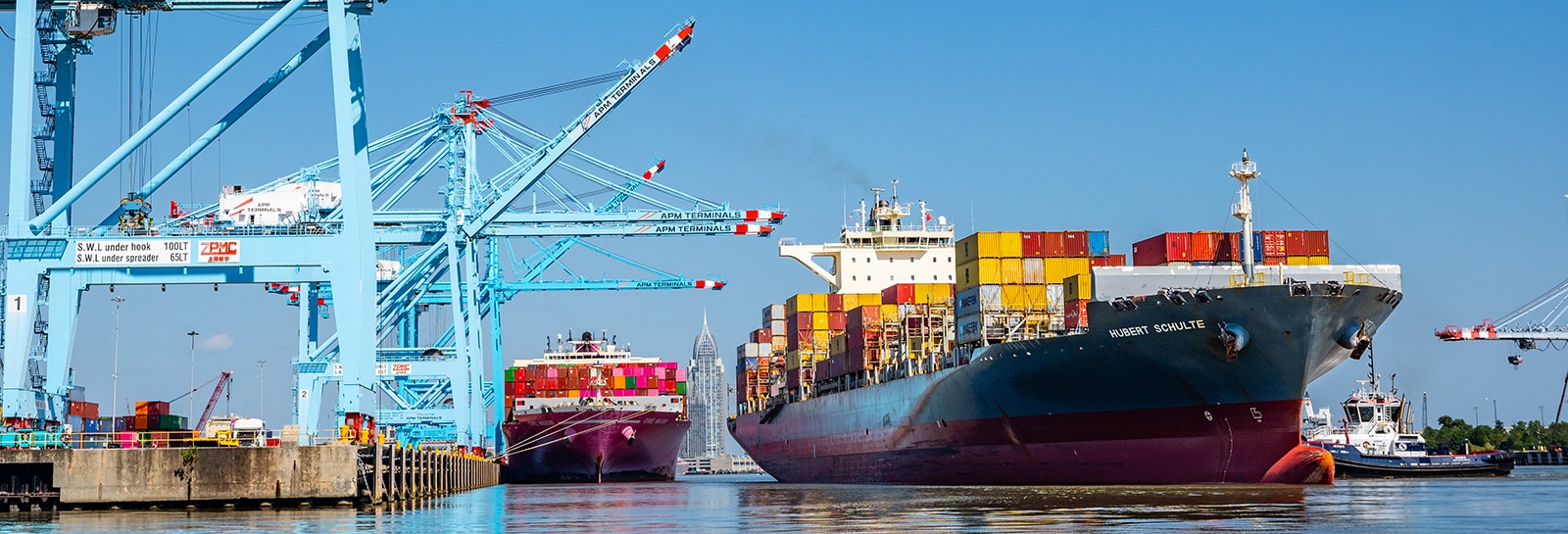
Spotlight on Mobile, Alabama
APM Terminals shares its perspective on the strategic role Mobile can play in enhancing supply chain resilience across the United States. Read how infrastructure investments and regional connectivity are unlocking new opportunities for cargo flow and economic growth.